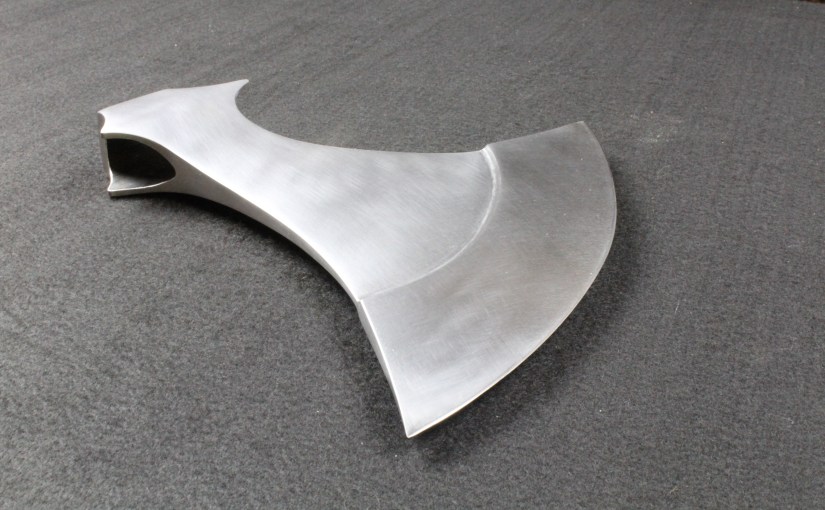
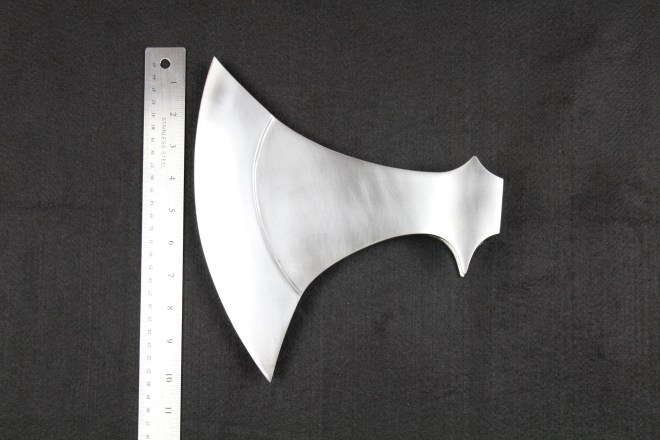
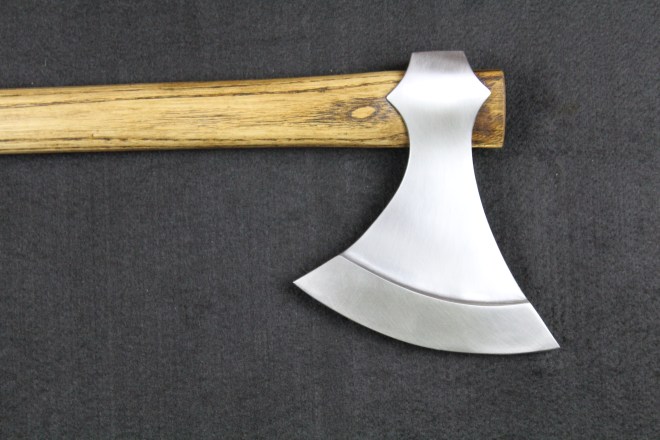
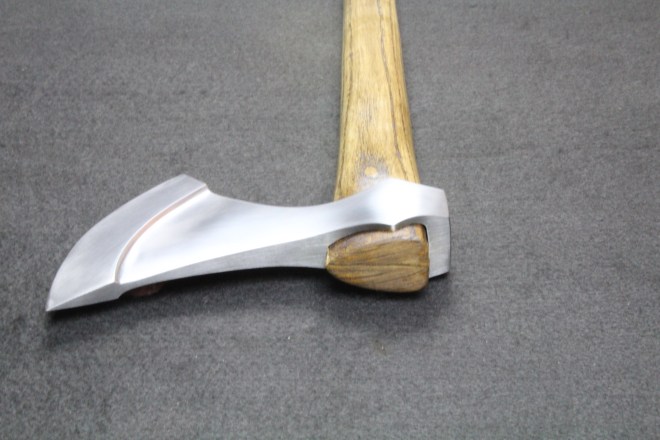
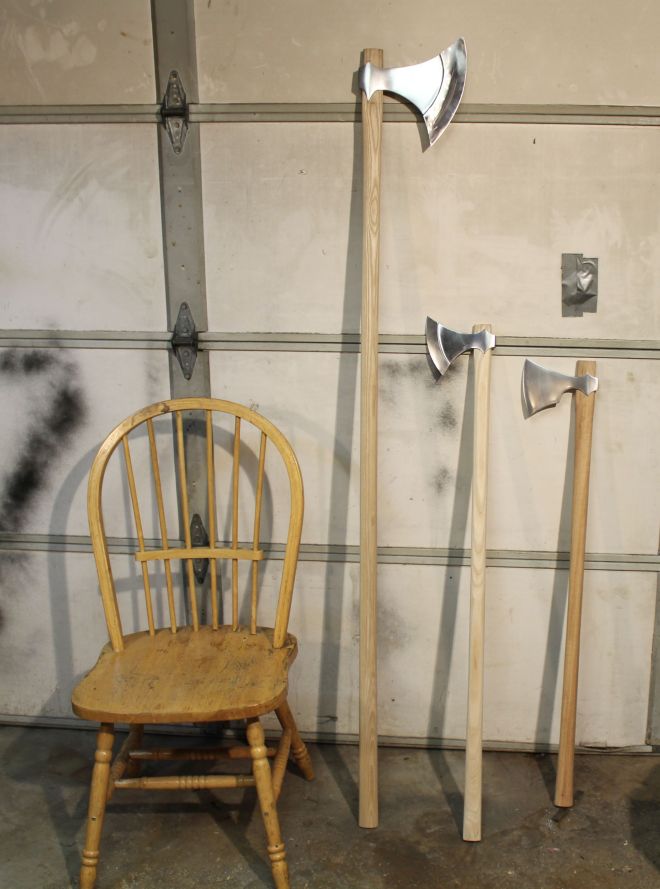
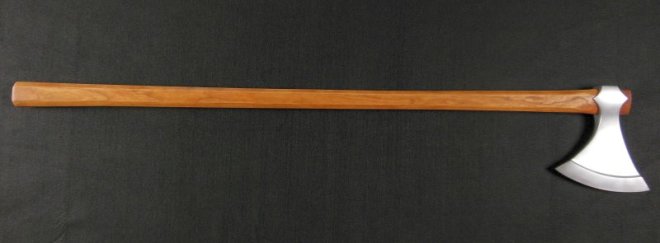
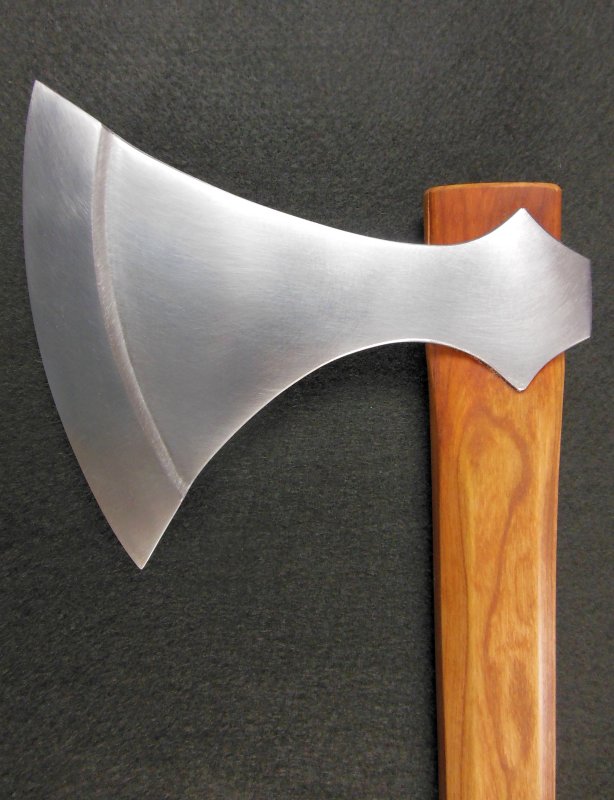
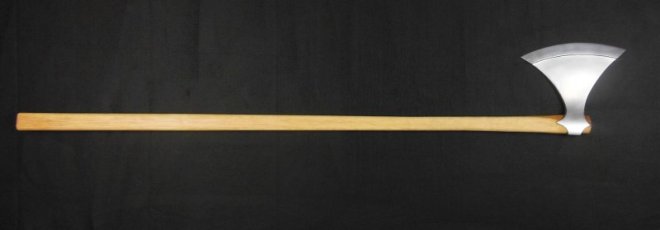
The first is a huge Danish Axe that is inspired from an axe in the Historical Museum in Stockholm.
The blade is 10.5″ (26,7 cm) from the toe to the heel of the blade. In spite of it’s aggressive distal taper, it weighs a bone crushing 1260 grams (2.8 pounds).
It features my usual construction: mild steel eye socket and body with 1080 high carbon steel edge. I had to ship this axe to Sweden, so the haft (made of ash) was not fitted to the head to save on shipping cost.
Small Type M
I received a request to make another small Danish axe like the one I made in March 2016. I won’t go into much detail because other than a few minor differences that resulted from hand forging, it is basically the same as the previous Small Type M. This seems to be a popular axe. I am considering doing a semi-custom version of it.
Large Bearded Axe
I had a request to do a larger version of the Bearded Axe from Uppsala I completed in February 2016. This axe features a blade that is 5.5″ from heel to toe. Like the smaller version, it has a wedged shaped distal taper which makes it into a wicked cutter. Like the small type M, this axe seems to be quite popular. I will look into doing a semi-custom version of this axe too.
Here is a picture of the three axes when I was test fitting the hafts. It provides a good side-by-side comparison:
If you are interested in more information about any of these axes, please contact me at eric@crownforge.net.
I haven’t updated my blog in months. During the winter and spring, it seemed like I would take time to update my blog at least once a week; but this summer has been a whirlwind of activity. Here is a sample:
Consulting at Albion Sword in New Glarus, WI
I’ve made numerous trips to Albion Swords in New Glarus, Wisconsin to help with training and fine tuning their heat-treat procedures and system. Albion’s head blade grinder, Craig Cheney, spent several days with me testing blades. The tests included but were not limited to bend tests, destructive tests, and edge impact testing. These test are a critical part of ensuring Albion’s quality.
Below is a video of Craig bend testing a blade. We bend the blade to 90 degrees in each direction to see if it will survive. We want it to bend without breaking. Following a good 90 degree bend test, we then bend the blade to 180 degrees. A passing blade will bend to past 90 degrees and achieve approximately 160 degrees of bend. As you will see, this blade definately passed the tests:
I should mention that the tests we are performing are considered abusive. Do not do this to your Albion swords.
Small Warehouse Completed
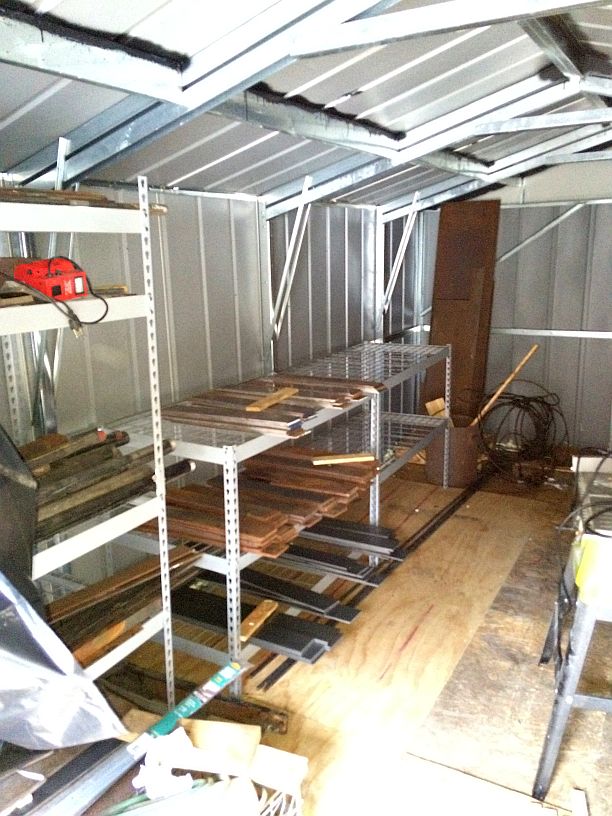
Completed the construction (with major help from my cousin Ron and my daughter Natalie) of a small warehouse to store my steel and wood. The warehouse will also hold some of my tools and wood working equipment. I am still moving steel and supplies into the warehouse. This process takes some time since I have to persuade my son to help me.
It will be apparent from the photo that I still have a lot of organizing to finish, but this small warehouse will create more floor space in my small shop:
KMG Grinder Modifications
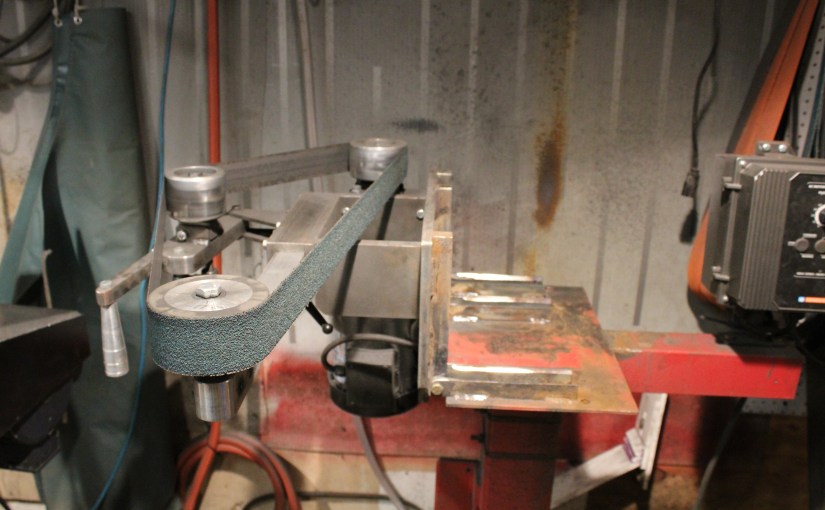
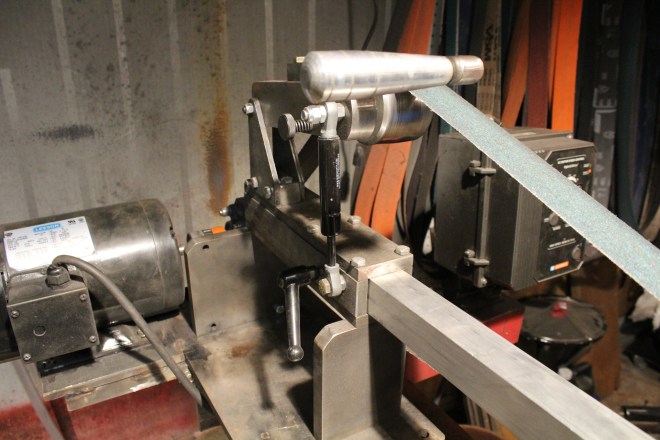
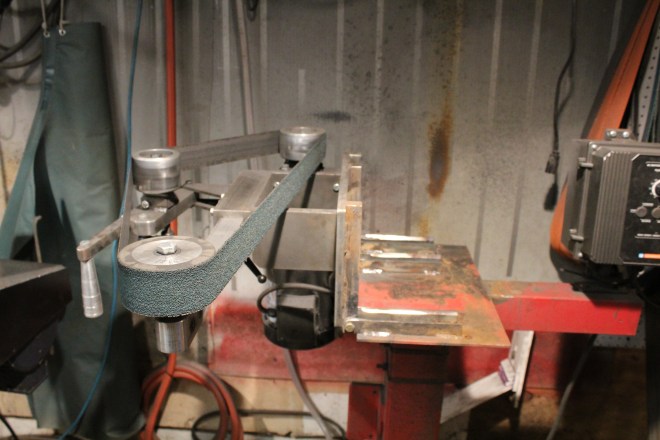
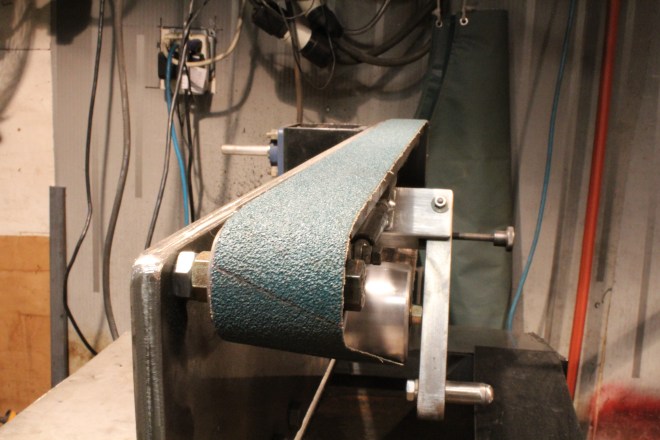
Modified and improved my KMG grinder. Most of the modifications were found on The Bladeforums. First, I eliminated the pulley wheels and belt and used a new motor mount that I made and connected the motor directly to the drive shaft with Lovejoy couplers. This eliminated a lot of the vibration associated with the belt and pulley system. Second, I removed the spring on the tracking arm and replaced it with a gas strut. The 40 pound gas strut provides enough force to make the belt tight and track very precisely. I also modified the grinder so that it could be tilted from the verticle position to the horizontal. This feature allows for the precise grinding of parts that require a radii.
The 40 pound gas strut (center) creates a very tight belt that tracks very precisely. Pictured in back is the new motor mount and Lovejoy couplers.Tilting the grinder to the horizontal position allows the use of various platens and different diameter wheels to grind an array of radii.
High Temperature Salt Bath
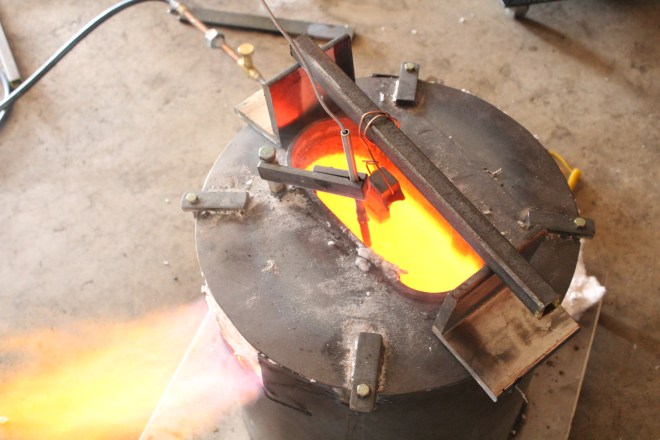
I created a new high temperature salt bath for heat-treating large axe heads. I call it the BAHT System: Big Axe Heat-Treat System. The oval stainless tube was fabricated by me in my shop. It allows for the heat-treating of axe blades up to 11.5″ wide!
Here is a video of the BAHT being charged the first time. Also in the video is my portable digital control system which include a LO/HI gas loop for almost “god-like” control of the salt bath temperature:
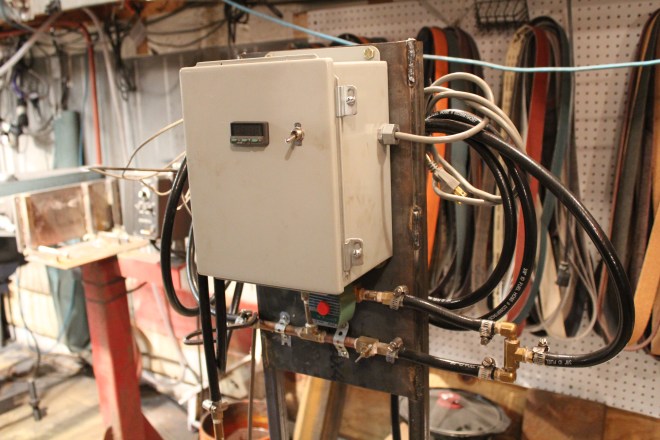
Bearded axe moments away from being quenched in oil.Close-up of the portable digital control unit.
The portable digital control unit can be moved between various high-temperature salt baths. It plugs into a 110v outlet, and it has the LO/HI pressure loop located below the box. On the other side is a port where the type K thermocoupler enters the control box. It is very easy to use. I have one bath for daggers and short blades, and another bath for sword length blades. I simply plug the power cord into an outlet or extension cord, connect the gas line to the LO/HI loop via a union, slide the thermocoupler into a small stainless steel tube on the different baths then fire it up. When I’m finished heat-treating, I move it into the warehouse for storage.
Sword Platen Grinder
I scraped my old sword platen grinder and build a new one from the ground up. It is still a work in progress but it works quite well for truing up bevels and creating complex distal tapers in sword and knife blades. The platen is 2″ wide by 28″ long and is made of precision ground tool steel. I still need to put a cover on motor and drive box, and install a water spray system.
I finished a new spray system that will be used on the platen grinder and he KMG which I will feature in an update in the near future. This spray system allows me to heat-treat blades that I am going to hollow-grind without the hollows ground in them. Hollow-ground bevels can create issues during heat-treat. Heat-treating without the hollows reduces the potential for warping. I then use the spray system to wet grind the blade without ruining the heat-treat.
I still have more things to fabricate, but this has been a producive summer even though I have not made many new items. The stage is set for some exciting projects in the near future.
If you have any questions on any of the things I’ve fabricated, feel free to email me at eric@crownforge.net.
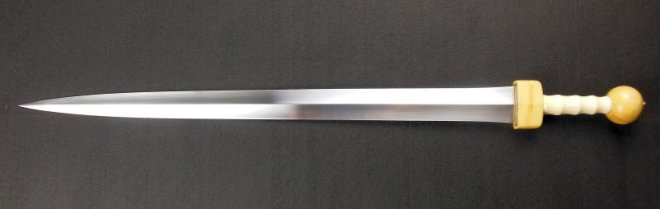
Just completed my interpretation of a late republic era Gladius Hispaniensis commission. This sword is based on the idea that the swords of the Celts served as possible inspiration for the shape and length of some Gladius Hispaniensis. The blade features a slight waisting and hollow-ground bevels.
The boxwood guard and pommel are made from the same block of wood. The beveled shape of the guard is based on a guard plate from one of the few surviving Gladius Hispaniensis blades. The blade is inset into a bronze guard plate that is countersunk into the bottom of the pommel. The overall shape of the guard is based on period art.
The pommel shape is based on period art and a survey of other late-republic era swords. The pommel is topped with a basic bronze rivet blockinto which the end of the tang is peened to secure the hilt furniture in place.
The grip is made from a block of holly and features a common, segmented shape.
Obviously, there are only hints as to what a Gladius Hispaniensis may have looked like intact. With this piece, I am not trying to say that this is the way that it would have looked. I am merely offering my interpretation of a possible configuration based on surviving blades, hilt pieces, and period art. I have to give credit to Peter Johnsson for many late night alcohol infused discussions about the Gladius Hispaniensis. I am not too proud to say that I borrowed liberally from the shape and features of a Gladius Hispaniensis that Peter made years ago. While it is true that many surviving blades feature a leaf shape, it is my opinion that this shape is over done in many modern reproductions. Peter’s design hints at a leaf shape without an exaggerated waisting of the blade. In addition, the blade is reminiscent of La Tené blades that feature a similar profile.
Specifications:
Blade Length: 24.75″ (62,9 cm)
Overall Length: 31.25″ (79,4 cm)
Blade Width: 1.875″ (4,8 cm) features hollow-ground bevels
POB from bottom of guard: 6″ (15,2 cm)
Weight: 1.37 pounds (622.3 grams)
Blade Steel: 1080
Hilt Furniture: Boxwood guard and pommel with bronze guard plate and bronze rivet block. Segmented grip made from a block of holly.
Price for similar piece:
Similar hilt with flat bevels, $1,800 USD (plus shipping)
Similar hilt with hollow-ground bevels, $2,300 USD (plus shipping)
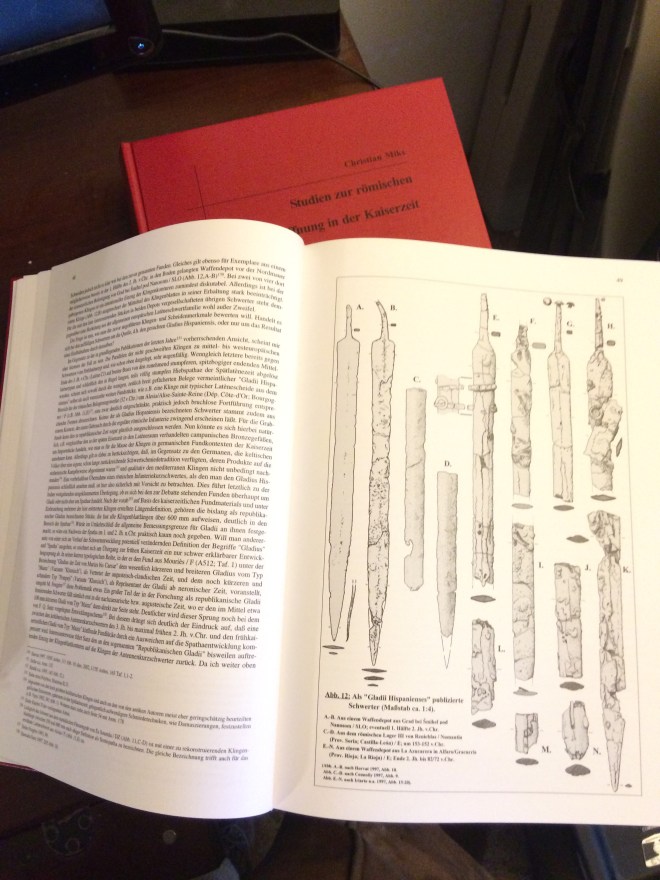
I just received my copy of Studien zur römischen Schwertbewaffnung in der Kaiserzeit Vol. 1 and 2 (Studies on the Roman sword under the Empire Vol. 1 and 2). It is a vast pool of information and pictures of Roman swords and accoutrements from the Republic era to the late Empire. It includes some important information about the Gladius Hispaniensis. These books arrived just in time to help inform my current project. The only downside is I do not read German, so it is a lot of translating with Google Translate which creates some interesting sentences in English. 😉
As some of you may know, when I am not making things in my shop, I am a union boilermaker in NW Indiana. Recently, I took a job at a local steel mill, so that explains the lack of updates on my blog. I have, however, managed to get some time off to work in the shop, so I thought I’d give a short update on what is in the works.
Hand polishing is always fun…or not! I took a commission for a Gladius Hispaniensis with a hollow ground blade. The blade is about 26″ (66,0 cm) long, and features shallow, hollow ground bevels. I have a few more grits to go, but it is nearly finished, and then it will be time for the hilt furniture. More pictures to follow.
I’m currently working on a Gladius Hispaniensis blade for a custom order. My intent is to make a late-Republic style sword. This blade has a deliberate Celtic influence, and features a hollow ground blade with a stout piecing tip. Peter Johnsson was a major influence on the shape of the blade. The blade is approximately 26″ long (66 cm). I have some Boxwood with some wonderful figuring which I will use for the hilt furniture. I will post more pictures as work progresses.
These last two weeks I’ve been working at Albion Swords in New Glarus, Wisconsin. It has been a productive two weeks. Albion recently promoted Matthew Schmitt to head cutler, so part of the focus was to help train Matt on techniques and processes. Albion also hired several new artisans who participated in the training sessions.
Another goal was to build and install a new high temperature salt bath. This is a critical piece of equipment that allows Albion to have very precise control over their heat-treat process. After a successful test start, I was able to commission the new system for production use.
Burners firing for the initial start-upMolten high temperature salt
This axe is inspired by a small Danish style axe (Petersen Type M) from Sweden. It features a stout construction with a reinforced edge.
Original from Uppsala, Sweden
This axe is not an exact reproduction. The original is quite corroded, so I attempted to estimate the missing sections of the profile. I also made a small departure from the tilt of the blade to make the axe a bit more visually pleasing. In addition, rust swelling has made determining the original dimensions difficult. I thinned out the thickness to allow for the rust swelling. The resulting axe is still quite stout for its size. This is a viciously fast cutter!
The haft is cherry wood (Prunus) treated with linseed oil, and it has an octogonal cross-section. I tapered the haft so that there is a pleasing arc that starts out wide at the head then tapers to a thinner section before it swells gradually to the end of the haft.. The wood displays some beautiful figuring on both sides of the haft.
Specifications:
Body and Eye: 1018 low carbon steel
Edge Bit: 1080 high carbon steel
Haft wood: Cherry (Prunus) treated with linseed oil
Blade Length (toe to heel of bit): 5.25″ (13,33 cm)
Description and Stats: The edge is 8.5″ (21,6 cm) from tip-to-tip. The haft is 42.5″ (108 cm) from the bottom of the eye. The eye and body are 1018 low carbon steel, and the edge is 1080 high carbon steel. The haft is made of hickory and has a gentle taper from the top to the bottom. It has a rectangular cross-section with rounded corners. I forgot to weigh it before I shipped it, but the new owner said it is almost exactly 3 pounds (1360,8 grams)
Some background information:
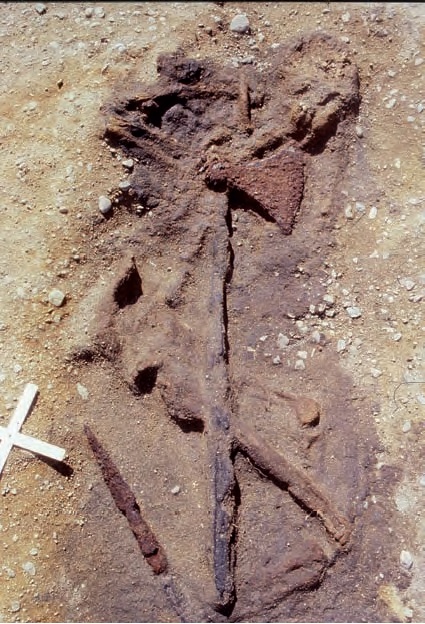
I was contacted about making a Danish style axe inspired by the grave finds in Kirkkomäki – specifically grave 37. As can see from the photo, it is quite corroded, but general shape and dimensions can be drawn from the picture:
Based on the information provided by the researchers, the customer wanted the haft length to be 42.5″ (108 cm) long. I asked the customer if I could fill in details with some research that I did with Peter Johnsson in Sweden. He agreed.
I used this axe as additional inspiration:
I have been working hard to hone my skills and techniques for making these Danish Axes. The reinforced edge, even though there is a slight radius from the body to the edge, are very difficult to clean up and make smooth. In my frustration, I made a sen to actually scrape and plane away material to make the arc smooth and consistent. Like many of my recent projects, this axe was another step forward for me. There are always small flaws that turn up (which I think add character to the piece); but overall, I am very satisfied with this axe.
Before I did the final clean-up I took this axe out back and attacked some large piece of wood (8-12″ in diameter) on my wood pile. I do this as a matter of habit to expose any possible hidden flaws in the structure of the axe. This time, I was really trying to see if I could get the axe to fail because the customer who commissioned the axe is a serious practitioner. I had to make sure this axe would not fail when he received it. I cut about 10 large pieces of wood with it. Striking full force, the blade performed brilliantly. I consider this fairly abusive since this axe is not tapered and balanced for continual wood cutting; the shape and weight allow for speed and agility in delivery massive blows in battle followed by a quick recovery. I would not recommend cutting large pieces of wood with this axe; it is, however, nice to know that the axe will hold up to this level of use.
Photos:
If you are interested in an axe similar to this one, contact me at ericmycue374@comcast.net, and we can discuss commissioning a piece.
Response from Michael Ruhala:
Hi Eric,
The axe arrived in fine shape and let me say this, it is a superb weapon! The weight, shape and proportion of the head is everything I hoped for. The handle is also noteworthy, its taper, cross section and smooth finish are as pleasing to the eye as they are comfortable in the hand. Taken as a whole the weapon is very well balanced, the weight of the blade combined with the rounded rectangular cross section of the handle make indexing and edge alignment practically automatic. According to my digital scale it weighs exactly 3lbs and the point of balance is about 8 inches below the eye, equidistant between the head and where I place my left hand in most guards. This makes for an agile weapon that can recover quickly even from a fully committed swing. Strikes with the handle are really fun because the head acts as a counterweight adding speed and force to blunt attacks. I’m mostly known as a swordsman but the axe has always had a special place in my heart, this one is the new centerpiece of my collection and I look forward to really putting it through its paces over the coming months.
I received some great comments from Michael Ruhala who was the fellow that commissioned the recently complete Danish axe that was inspired by the Kirkkomäki grave 37 find. Michael is a competitive swordsman who likes to practice with a variety of ancient weapons:
Hi Eric,
The axe arrived in fine shape and let me say this, it is a superb weapon! The weight, shape and proportion of the head is everything I hoped for. The handle is also noteworthy, its taper, cross section and smooth finish are as pleasing to the eye as they are comfortable in the hand. Taken as a whole the weapon is very well balanced, the weight of the blade combined with the rounded rectangular cross section of the handle make indexing and edge alignment practically automatic. According to my digital scale it weighs exactly 3lbs and the point of balance is about 8 inches below the eye, equidistant between the head and where I place my left hand in most guards. This makes for an agile weapon that can recover quickly even from a fully committed swing. Strikes with the handle are really fun because the head acts as a counterweight adding speed and force to blunt attacks. I’m mostly known as a swordsman but the axe has always had a special place in my heart, this one is the new centerpiece of my collection and I look forward to really putting it through its paces over the coming months.
It was a pleasure making this axe for Michael. He provided good input into the design of the axe head, and was very patient when I had restarts and delays.





















 Crown Forge